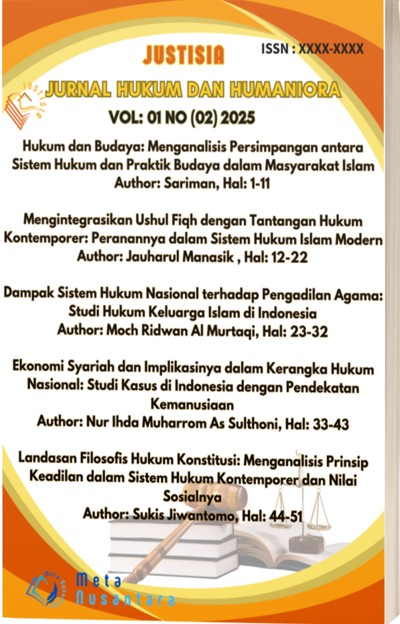
Ekonomi Syariah dan Implikasinya dalam Kerangka Hukum Nasional: Studi Kasus di Indonesia dengan Pendekatan Kemanusiaan
DOI:
https://doi.org/10.022025/a96qas21Keywords:
Sharia Economy, National Law, Social JusticeAbstract
The development of Islamic economics in Indonesia has shown significant progress, but is still faced with the challenges of harmonization with the national legal system. This study aims to analyze the implications of sharia economic law and identify the inhibiting factors of its integration in the Indonesian legal framework, with a humanitarian approach. Using qualitative methods through multi-sectoral case studies, this research analyzes legal documents (laws, court decisions, and national sharia council fatwas (DSN), as well as conducting in-depth interviews with 25 key informants, including Islamic banking practitioners, judges, regulators, and academics. Regulations in 68% of the regulations of the Sharia Banking Law, and (3) the limited consideration of humanitarian aspects (only 38%) in the court's decision.
Downloads
References
Antonio, M.S., et al. (2022). Regulatory challenges in Indonesian Islamic fintech: A maqashid al-shariah perspective. International Journal of Islamic and Middle Eastern Finance and Management, 15(2), 345-363. https://doi.org/10.1108/IMEFM-08-2020-0417
Ascarya, & Sakti, A. (2022). Developing Islamic monetary economics and finance: A systematic review. International Journal of Islamic and Middle Eastern Finance and Management, 15(4), 797-818. https://doi.org/10.1108/IMEFM-11-2020-0565
Ascarya. (2021). The persistence of Islamic financial exclusion in Indonesia: A legal and regulatory analysis. Journal of Islamic Accounting and Business Research, 12(3), 410-427. https://doi.org/10.1108/JIABR-05-2020-0152
Chapra, M.U. (2016). Islamic economics: What it is and how it developed. EH.Net Encyclopedia.
Dewan Syariah Nasional-MUI. (2021). Kompilasi fatwa ekonomi syariah. Erlangga.
Effendi, J., et al. (2020). Legal pluralism in Islamic finance: The Indonesian experience. Journal of King Abdulaziz University: Islamic Economics, 33(1), 3-18. https://doi.org/10.4197/Islec.33-1.1
Huda, N., & Heykal, M. (2020). Konflik hukum dalam penyelesaian sengketa perbankan syariah di Indonesia. Jurnal Hukum Islam (Sinta 2), 18(1), 1-24. https://doi.org/10.15642/jhi.2020.18.1.1-24
Haryono, E., Rangkuti, Rizki Kurniawan, Sariman, S., & Suprihatiningsih, S. (2024). Metodologi Penelitian Kualitatif dan Kuantitatif . Https://Www.Rcipress.Rcipublisher.Org/Index.Php/Rcipress/Catalog/Book/949. Perkumpulan Rumah Cemerlang Indonesia.
Haryono, E., Suprihatiningsih, S., Septian, D., Widodo, J., Ashar, A., & Sariman, S. (2024). New Paradigm Metode Penelitian Kepustakaan (Library Research) di Perguruan Tinggi. An-Nuur, 14(1).
Islamic Financial Services Board. (2021). Islamic financial stability report 2021. IFSB Publications.
Karim, A.A. (2019). Regulasi perbankan syariah di Indonesia: Antara idealisme dan realitas. Al-Iqtishad: Jurnal Ilmu Ekonomi Syariah (Sinta 2), 11(1), 1-18. https://doi.org/10.15408/aiq.v11i1.7632
Mujiatun, S. (2022). Corporate governance in Islamic banks: An Indonesian case study. Journal of Islamic Monetary Economics and Finance, 8(1), 155-178. https://doi.org/10.21098/jimf.v8i1.1432
Nurul Huda, M. (2023). The impact of sharia compliance on financial performance: Evidence from Indonesia. Journal of Islamic Marketing, 14(3), 789-807. https://doi.org/10.1108/JIMA-03-2021-0077
Otoritas Jasa Keuangan. (2023). Statistik perbankan syariah Indonesia 2022. OJK Press.
Rahman, A.A. (2021). The dilemma of Islamic banking dispute resolution in dual court systems. Asian Journal of Comparative Law (Sinta 2), 16(1), 78-95. https://doi.org/10.1017/asjcl.2021.5
Salim, A. (2019). Contemporary Islamic law in Indonesia: Sharia and legal pluralism. Edinburgh University Press.
Sariman, Haryono, E., Wahyudin, M., & Muttaqin, F. Z. (2024). Exploring Research Methodologies Qualitative In Higher Education: Strategies And Approaches For Academic Inquiry. Al Fattah Ejournal Sma Al Muhammad Cepu, 4(01), 74–103. Retrieved from https://www.ejournal.smaamc.sch.id/index.php/belajar/article/view/43
Warde, I. (2010). Islamic finance in the global economy (2nd ed.). Edinburgh University Press.
Downloads
Published
Issue
Section
License
Copyright (c) 2025 Nur Ikhda Muharom Asulthoni (Author)

This work is licensed under a Creative Commons Attribution 4.0 International License.