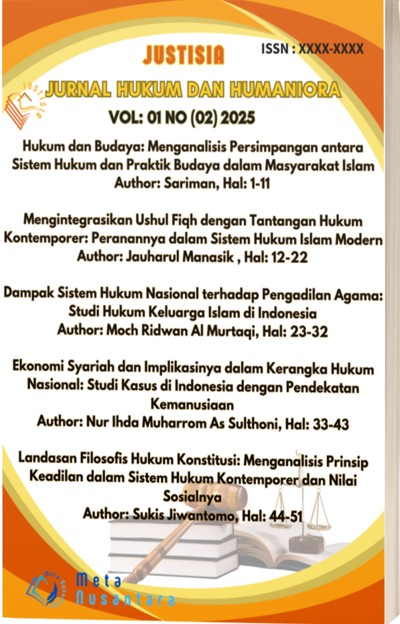
Mengintegrasikan Ushul Fiqh dengan Tantangan Hukum Kontemporer: Peranannya dalam Sistem Hukum Islam Modern
DOI:
https://doi.org/10.022025/qw0h2x94Keywords:
Digital Fiqh, Mursalah Maslahah, Qiyas DigitalAbstract
This study aims to analyze the integration between the principle of Usul Fiqh and modern law, especially in the application of fiqh on digital technology issues. This study uses the Mixed-Methods Explanatory Sequential Design approach, which combines the initial quantitative analysis with qualitative interviews to understand more in the challenges that arise. Primary data were obtained from DSN-MUI fatwa (2019-2024) and the decision of the Religious Courts, analyzed through content analysis to find the pattern of using the Usul Fiqh method. In addition, a survey with 120 religious court judges was conducted using a questionnaire that had been tested for validity with Cronbach’s Alpha (α = 0.87). Semi-structured interviews are also conducted to 15 fiqh experts and digital law. The results showed that the Mursalah problem method was more often applied in DSN-MUI fatwa related to fintech and bioethics (68%), while Qiyas was only used in 22% of cases. In addition, the judge faces difficulties in applying istihsan to digital inheritance, and the concept of classic 'classical is inadequate to overcome issues related to digital assets such as NFT and Cryptocurrency. This study also found a shift in the fatwa authority to digital influencers and challenges in the Islamic education system that did not fully adapt to digital literacy. From this finding, research suggested the development of fiqh technology curriculum and digital competency certification for ulama, as well as the application of digital qiyas to overcome legal issues in the context of technology.
Downloads
References
Al-Qaradawi, Y. (2018). Fiqh al-hadithah: Contemporary issues in Islamic law. Dar al-Shorouk.
Ascarya, A. (2022). The missing link in Islamic finance: Application of maqasid al-Shari'ah. Journal of Islamic Accounting and Business Research, 13(3), 421-440.
Auda, J. (2021). Maqasid al-Shariah for blockchain technology. International Institute of Islamic Thought.
Bakar, M. D. (2020). Digital fiqh: Reconstructing Islamic legal methodology. International Journal of Islamic Thought, 18(1), 45-63.
DiMaggio, P. J., & Powell, W. W. (1983). The iron cage revisited: Institutional isomorphism and collective rationality. American Sociological Review, 48(2), 147-160.
DSN-MUI. (2024). Standar fatwa digital. Dewan Syariah Nasional.
Faricha, F., & Sariman, S. (2024). Peran Lembaga Pendidikan Islam Pada Dalam Membentuk Generasi Muslim Yang Kompetitif. Al Fattah Ejournal Sma Al Muhammad Cepu, 5(02), 36–57.
Haryono, E., Suprihatiningsih, S., Septian, D., Widodo, J., Ashar, A., & Sariman, S. (2024). New Paradigm Metode Penelitian Kepustakaan (Library Research) di Perguruan Tinggi. An-Nuur, 14(1).
Haryono Eko Rangkuti Rizki Kurniawan, Sariman, S. S. (2024). Metodologi Penelitian Kualitatif dan Kuantitatif. Https://Www.Rcipress.Rcipublisher.Org/Index.Php/Rcipress/Catalog/Book/949. Perkumpulan Rumah Cemerlang Indonesia
Hair, J. F., et al. (2022). Partial least squares structural equation modeling (PLS-SEM). Sage.
Hallaq, W. B. (2013). The impossible state: Islam, politics, and modernity's moral predicament. Columbia University Press.
Kementerian Agama RI. (2023). Laporan tahunan peradilan agama 2023. Badan Litbang dan Diklat Kemenag.
Nurhidayat, A. (2022). Qiyas in digital era: Determining 'illah for crypto assets in Indonesia. Journal of Islamic Law Studies, 8(3), 78-95.
Ramadan, T. (2023). Islamic law and the digital transformation. Oxford University Press.
Santos, B. de S. (1987). Law: A map of misreading. Journal of Law and Society, 14(3), 279-302.
Syarif, N. (2023). Curriculum reform for Islamic law in digital age. Indonesian Journal of Islamic Education, 15(2), 112-130.
Salim, A. (2015). Contemporary Islamic Law in Indonesia: Sharia and Legal Pluralism. Edinburgh University Press.
Santoso, M. (2025). Etika Profesi Hukum. Meta Nusantara. Blora: Meta Nusantara.
Santoso, M., Habibi, R., Falah, A., & Haryono, E. (2025). Filsafat Umum. Meta Nusantara. Blora: Meta Nusantara. Retrieved from https://repository.metanusantara.com/publications/617595/filsafat-umum#cite
Teubner, G. (1992). Law as autopoietic system. Blackwell.
Van Dijk, J. (2020). The digital divide. Polity Press.)
Downloads
Published
Issue
Section
License
Copyright (c) 2025 Jauhari Manasik (Author)

This work is licensed under a Creative Commons Attribution 4.0 International License.