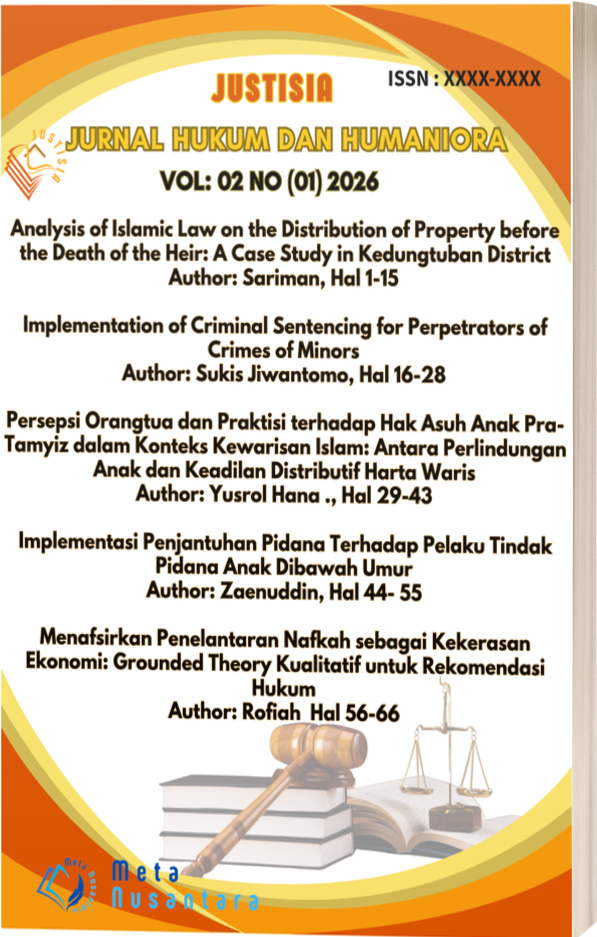
Implementation of Criminal Sentencing for Perpetrators of Crimes of Minors
DOI:
https://doi.org/10.022025/xxqk1922Keywords:
Sentencing Of Children, Restorative Justice, Judges' Decisions, DiversionAbstract
Prison sentences against children in conflict with the law are still dominant in judicial practice in many developing countries, although legal frameworks have adopted restorative justice. This study aims to analyze the pattern of implementation of criminal penalties against juvenile offenders and identify factors that influence the judge's decision. This study uses a sequential explanatory mixed methods design. The primary data source was obtained from in-depth interviews with 24 informants consisting of six juvenile judges, four public prosecutors, four legal advisors, four Bapas social workers, and six child offenders who have served criminal sentences, as well as observations of ten trials. Secondary data in the form of 150 court decisions for the 2019–2025 period were analyzed statistically descriptive and inferential. The results of the study showed that 62% of the verdicts imposed prison sentences, especially for cases of violence (78%) and theft with aggravation (71%). The three dominant factors that affect judges are the pressure of the victim's family (81%), the limitations of rehabilitation facilities (73%), and the recommendations of community research reports that are often ignored (68%). A significant gap was found between normative commitments to restorative justice and judicial practice, where only 22% of judgments fully reflected these principles. This study concludes that the implementation of juvenile punishment is still retributive and requires binding penal guidelines and strengthening rehabilitation infrastructure
Downloads
References
Cipriani, D. (2016). Children’s Rights and the Minimum Age of Criminal Responsibility: A Global Perspective. International Journal of Children’s Rights, 24(3), 601–633.
Creswell, J. W., & Creswell, J. D. (2018). Research Design: Qualitative, Quantitative, and Mixed Methods Approaches (5th ed.). Sage Publications.
Eko, H., Suprihatiningsih, S., Kurniawan Rangkuti, R., & Sariman, S. (2024). Metodologi Penelitian Kualitatif dan Kuantitatif . Perkumpulan Rumah Cemerlang Indonesia.
Fetters, M. D., Curry, L. A., & Creswell, J. W. (2013). Achieving integration in mixed methods designs—principles and practices. Health Services Research, 48(6pt2), 2134–2156.
Field, S., & Nelken, D. (2016). Judicial Discretion and Youth Justice: A Comparative Analysis. Journal of Law and Society, 43(2), 215–242.
Goldson, B., & Muncie, J. (2015). Youth Crime and Justice (2nd ed.). Sage Publications.
Hazel, N. (2020). Cross-National Variation in Youth Justice Systems: The Role of Institutional Context. Criminology & Criminal Justice, 20(4), 456–474.
Hosmer, D. W., Lemeshow, S., & Sturdivant, R. X. (2013). Applied Logistic Regression (3rd ed.). John Wiley & Sons.
Hox, J. J. (2017). Applied Multilevel Analysis (2nd ed.). Routledge.
Kutateladze, B. L., Andiloro, N. R., Johnson, B. D., & Spohn, C. C. (2019). Coding Judicial Decisions: Reliability and Validity in Sentencing Research. Criminal Justice and Behavior, 46(5), 711–730.
Liefaard, T. (2019). Deprivation of Liberty of Children in the Justice System: Towards a Rights-Based Approach. International Journal of Children’s Rights, 27(4), 641–670.
Lincoln, Y. S., & Guba, E. G. (1985). Naturalistic inquiry. SAGE Publications.
Lindsey, T., & Santoso, M. A. (2019). Diversion and Restorative Justice in Indonesia’s Juvenile Justice System. Asian Journal of Law and Society, 6(1), 89–114.
Lynch, M. (2017). Judicial Attitudes Toward Juvenile Offenders in Latin America. International Journal of Law and Psychiatry, 51, 23–31.
Muncie, J. (2014). Youth Justice: Global and Local. Sage Publications.
Patton, M. Q. (2015). Qualitative Research & Evaluation Methods: Integrating Theory and Practice (4th ed.). Sage Publications.
Petrosino, A., Turpin-Petrosino, C., & Guckenburg, S. (2019). Formal System Processing of Juveniles: Effects on Delinquency. Campbell Systematic Reviews, 15(1–2), e1016.
Priebe, G., & Hirvikoski, T. (2021). Social Welfare Reports and Judicial Decision-Making in Juvenile Courts. Child and Adolescent Psychiatry and Mental Health, 15(1), 22–34.
Sherman, L. W., & Strang, H. (2019). Restorative Justice: The Evidence. Annual Review of Criminology, 2, 251–272.
Spradley, J. P. (2016). Participant observation. Waveland Press.
Tarigan, R. S. (2024a). Dinamika implementasi putusan mahkamah konstitusi. Ruang Karya Bersama.
Tarigan, R. S. (2024b). Hukum Acara Mahkamah Konstitusi. AMU Press, 1–241.
Tarigan, R. S. (2024c). Konstitusi Dan Kekuasaan Studi Kasus Dalam Hukum Tata Negara. Ruang Karya Bersama.
TARIGAN, R. S. (2024). Mahkamah Konstitusi Dalam Sistem Ketatanegaraan Indonesia. Ruang Karya Bersama.
Tarigan, R. S. (2024d). Menuju negara hukum yang berkeadilan. Ruang Karya Bersama.
Tarigan, R. S., SH, M. H., Syafri Hariansah, S. H., MH, M. A. Z., & SH, M. H. (2026). PENGANTAR ILMU HUKUM: Dasar-Dasar & Fundamental Sistem Hukum. PT. Revormasi Jangkar Philosophia.
Vandaele, A. (2020). Media Pressure and Sentencing in Juvenile Courts: A European Perspective. European Journal of Criminology, 17(5), 623–642.
Wahyudi, S. (2018). Implementation of Restorative Justice in Indonesian Juvenile Courts. Indonesian Journal of Criminal Law, 9(2), 145–162.
Zimring, F. E. (2018). Proportionality and the Juvenile Offender. Journal of Criminal Law and Criminology, 108(3), 541–568.
Zimring, F. E., & Langer, M. (2021). The Future of Juvenile Sentencing Reform. Oxford Journal of Legal Studies, 41(2), 389–412.
Downloads
Published
Issue
Section
License
Copyright (c) 2026 Sukis Jiwantomo (Author)

This work is licensed under a Creative Commons Attribution 4.0 International License.