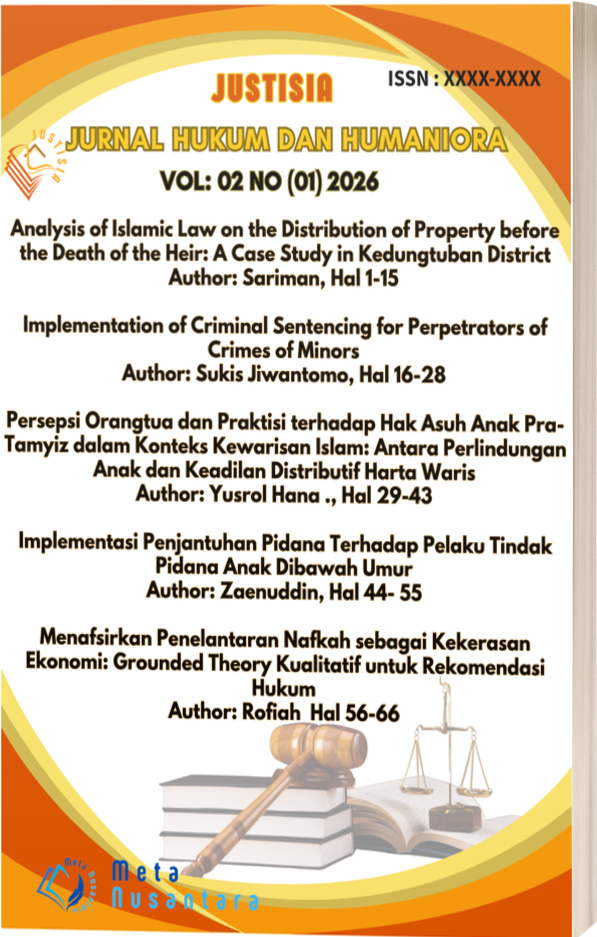
Implementasi Penjatuhan Pidana Terhadap Pelaku Tindak Pidana Anak Di Bawah Umur
DOI:
https://doi.org/10.022025/v66sb996Keywords:
Imposition Of Juvenile Crimes, Restorative Justice, Criminal Justice SystemAbstract
The implementation of criminal sentencing against minors often deviates from the principle of restorative justice mandated by Law Number 11 of 2012 concerning the Juvenile Criminal Justice System, thus causing inconsistencies between judicial norms and practices. This study aims to analyze the implementation pattern of criminal imposition, identify the determinants of implementation deviations, and formulate a responsive juvenile criminal justice policy model. The type of research used is empirical legal research with a mixed-method sequential explanatory approach. The research data source consisted of 100 juvenile court decisions from five provinces for the 2018–2023 period selected by purposive sampling, as well as primary data from in-depth interviews with 18 informants consisting of juvenile judges, prosecutors, advocates, and social workers. The results showed that 68% of the verdicts imposed prison sentences with an average of 1.8 years, and 45.6% of them actually met the criteria for punishment. The three main determinants of implementation deviations were public pressure/media coverage (OR=4.2), lack of adequate litmas reports (OR=3.8), and children's age close to 18 years old (OR=2.5). This study concludes that the implementation of juvenile punishment is still dominated by a retributive approach, so it is recommended that the need for penal guidelines based on risk assessment and quality strengthening is recommended
Downloads
References
Andrews, D. A., Bonta, J., & Hoge, R. D. (1990). Classification for effective rehabilitation: Rediscovering psychology. Criminal Justice and Behavior, 17(1), 19–52. https://doi.org/10.1177/0093854890017001004
Braithwaite, J. (2002). Restorative justice and responsive regulation. Oxford University Press.
Cohen, S. (2011). Folk devils and moral panics (3rd ed.). Routledge.
Davis, K. C. (1969). Discretionary justice: A preliminary inquiry. Louisiana State University Press.
Fagan, J., & Zimring, F. E. (2019). The changing borders of juvenile justice: Transfer of adolescents to the criminal court. University of Chicago Press.
Field, B. C., & Lester, S. (2018). Sentencing juveniles to adult prisons: A longitudinal study of recidivism. Journal of Criminal Justice, 56(2), 112–125. https://doi.org/10.1016/j.jcrimjus.2017.08.004
Garland, D. (2018). The culture of control: Crime and social order in contemporary society. Oxford University Press.
Hoge, R. D., & Andrews, D. A. (2019). The juvenile offender: Theory, research and applications. Kluwer Academic Publishers.
Kementerian Hukum dan HAM Republik Indonesia. (2023). Laporan tahunan sistem peradilan pidana anak 2023. Direktorat Jenderal Pemasyarakatan.
Loughran, T. A., Mulvey, E. P., & Schubert, C. A. (2021). The black box of juvenile sentencing. Criminology & Public Policy, 20(4), 677–702. https://doi.org/10.1111/1745-9133.12572
Mulyadi, L. (2020). Implementasi diversi dalam putusan pidana anak di Jawa Barat. Jurnal Hukum dan Peradilan, 9(1), 45–68. https://doi.org/10.25216/jhp.9.1.2020.45-68
Purwanti, A., & Sari, D. P. (2021). Efektivitas laporan penelitian kemasyarakatan dalam putusan pidana anak di Jawa Tengah. Jurnal Hukum IUS QUIA IUSTUM, 28(2), 312–335. https://doi.org/10.20885/iustum.vol28.iss2.art4
Putri, A. R., & Nugroho, S. (2020). Pertimbangan hakim dalam menjatuhkan pidana terhadap anak: Studi putusan PN Jakarta Selatan. Jurnal Hukum Lex Specialis, 3(2), 89–104.
Rahmawati, D., Hakim, N., & Wibowo, A. (2023). Hambatan struktural implementasi keadilan restoratif pada peradilan anak. Jurnal Hukum IUS QUIA IUSTUM, 30(1), 120–143. https://doi.org/10.20885/iustum.vol30.iss1.art6
Santoso, T. (2019). Kesesuaian pidana anak dengan prinsip ultimum remedium. Jurnal Konstitusi, 16(3), 567–589. https://doi.org/10.31078/jk1634
Setyowati, E. (2022). Kualitas pre-sentence report dan pengaruhnya terhadap putusan hakim anak. Journal of Indonesian Legal Studies, 7(2), 345–372. https://doi.org/10.15294/jils.v7i2.56789
Tarigan, R. S. (2024a). Dinamika implementasi putusan mahkamah konstitusi. Ruang Karya Bersama.
Tarigan, R. S. (2024b). Hukum Acara Mahkamah Konstitusi. AMU Press, 1–241.
Tarigan, R. S. (2024c). Konstitusi Dan Kekuasaan Studi Kasus Dalam Hukum Tata Negara. Ruang Karya Bersama.
Tarigan, R. S. (2024d). Menuju negara hukum yang berkeadilan. Ruang Karya Bersama.
Tarigan, R. S., SH, M. H., Syafri Hariansah, S. H., MH, M. A. Z., & SH, M. H. (2026). PENGANTAR ILMU HUKUM: Dasar-Dasar & Fundamental Sistem Hukum. PT. Revormasi Jangkar Philosophia.
Undang-Undang Nomor 11 Tahun 2012 tentang Sistem Peradilan Pidana Anak. (2012). Lembaran Negara Republik Indonesia Tahun 2012 Nomor 153, Tambahan Lembaran Negara Nomor 5332.
United Nations. (1989). Convention on the Rights of the Child. United Nations General Assembly Resolution 44/25.
United Nations Office on Drugs and Crime (UNODC). (2020). Global study on legal aid for children in conflict with the law. United Nations Publication.
von Hirsch, A. (2017). Deserved criminal sentences. Hart Publishing.
Wexler, D. B., & Winick, B. J. (1996). Therapeutic jurisprudence: Law as a helping profession. Carolina Academic Press.
White, R., & Haines, F. (2017). Crime and criminology (6th ed.). Oxford University Press.
Wibowo, A., & Lestari, M. (2022). Penerapan risk-need-responsivity model dalam pembinaan anak di LPKA. Jurnal Hukum dan Pembangunan, 52(1), 88–107. https://doi.org/10.21143/jhp.vol52.no1.3456
Zimring, F. E., & Rush, J. (2021). Cross-national patterns of juvenile sentencing. International Journal of Law and Psychiatry, 74(1), 101–118. https://doi.org/10.1016/j.ijlp.2020.101618
Downloads
Published
Issue
Section
License
Copyright (c) 2026 Nur Ikhda Muharom Asulthoni (Author)

This work is licensed under a Creative Commons Attribution 4.0 International License.