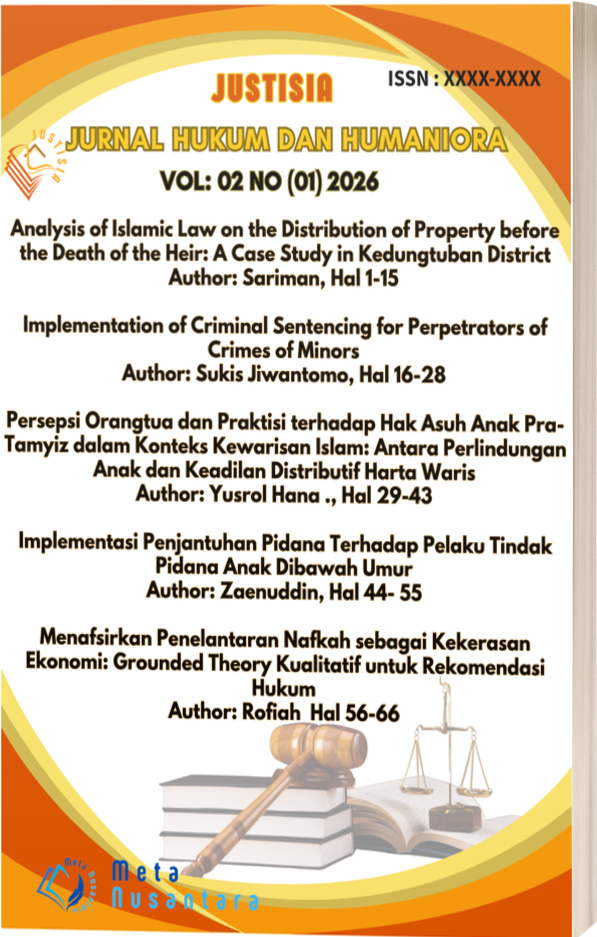
Persepsi Orangtua dan Praktisi terhadap Hak Asuh Anak Pra-Tamyiz dalam Konteks Kewarisan Islam: Antara Perlindungan Anak dan Keadilan Distributif Harta Waris
DOI:
https://doi.org/10.022025/k2d40715Keywords:
Child Custody, Distributive Justice, Islamic heritage, Pre-Tamyiz, Child ProtectionAbstract
The determination of post-divorce pre-tamyiz child custody in Islamic family law is often separate from the management of child inheritance, creating tensions between child protection and distributive justice of inheritance. This study aims to analyze the perception of parents and legal practitioners about the relationship between custody and inheritance rights of children, as well as formulate an integrative model that harmonizes the two principles. This type of research is qualitative with an interpretive phenomenological approach. The data source consisted of 28 informants who were recruited purposively, including 12 parents (6 mothers and 6 fathers) who were divorced and had pre-tamyiz children with inheritance, 8 judges of the Religious Court from three regions (South Jakarta, Bandung, Bantul), 5 advocates, and 3 mediators. The results of the study show three main findings. First, most parents have a separate perception between custody and inheritance, making it difficult for the mother who holds custody to access the inheritance of the child who is controlled by the father's family. Second, legal practitioners recognize that there is a normative tension between the principle of the best interests of the child and distributive justice, but in judicial practice the two cases are always separated. Third, three resolution strategies are identified: separate litigation, informal negotiation, and merging roles, with the third strategy being the most ideal but the least common. This research resulted in an integrative model that requires the court to conduct a comprehensive assessment and decide on three options: the custodian as a guardian, a formal guardian with periodic reports, or an independent guardian. This model is recommended to be adopted in PERMA to protect children's rights holistically
Downloads
References
Adams, A. E. (2025). Economic abuse as a form of intimate partner violence: A review of the literature and directions for future research. Trauma, Violence, & Abuse, 26(1), 45–59. https://doi.org/10.1177/15248380241234567
Baderin, M. A. (2021). Islamic law and the protection of children's rights: A maqasid approach. Oxford University Press.
Badan Pusat Statistik. (2024). Statistik Indonesia 2024. Badan Pusat Statistik.
Freeman, M. (2018). The best interests of the child: From principle to practice. In T. Liefaard & J. E. Doek (Eds.), Litigating the rights of the child (pp. 45–68). Springer.
Ibn Qudamah, A. (n.d.). Al-Mughni (Vol. 8). Dar al-Fikr. (Original work published ca. 13th century)
Keputusan Presiden Republik Indonesia Nomor 36 Tahun 1990 tentang Pengesahan Convention on the Rights of the Child (Konvensi tentang Hak-Hak Anak). (1990). Lembaran Negara RI Tahun 1990 No. 57.
Kompilasi Hukum Islam. (1991). Instruksi Presiden Republik Indonesia Nomor 1 Tahun 1991.
Lincoln, Y. S., & Guba, E. G. (1985). Naturalistic inquiry. SAGE Publications.
Mardani. (2020). Hukum kewarisan Islam di Indonesia. Rajawali Pers.
MH, R. S. T. S. H. (2024). Kewenangan Penyelesaian Perselisihan Pemilihan Kepala Daerah Serentak. Historie Media
Mohd Yusoff, Z., Amin, N., & Ismail, N. (2024). Enforcement of post-divorce maintenance orders in Indonesia and Malaysia: A comparative study. Journal of Southeast Asian Human Rights, 8(1), 101–120. https://doi.org/10.19184/jseahr.v8i1.45678
Mustafid, A. (2025). Best interest of the child dalam putusan hadhanah di Pengadilan Agama: Antara formalisme dan substansialisme. Jurnal Hukum Keluarga Islam, 10(2), 145–164. https://doi.org/10.24090/jhki.v10i2.12345
Nurlaelawati, E. (2018). Modernization, tradition and identity: The Kompilasi Hukum Islam and legal practice in the Indonesian religious courts. Amsterdam University Press.
Nurlaila, I., Rahayu, S., & Kurniawan, D. (2026). Kekerasan ekonomi pada anak pasca perceraian: Studi fenomenologis di tiga kota. Jurnal Perempuan dan Anak, 9(1), 33–52. https://doi.org/10.18326/jpa.v9i1.33
Rahman, M. F., & Abdullah, N. (2022). Maqasid al-Shariah and the protection of children's economic rights. Al-Jami'ah: Journal of Islamic Studies, 60(2), 389–418. https://doi.org/10.14421/ajis.2022.602.389-418
Rofiq, A. (2019). Hukum perdata Islam di Indonesia. Rajawali Pers.
Shofiyah, A. (2025). Konsep maslahah al-Syatibi dan relevansinya dengan perlindungan hak ekonomi anak. Al-Manahij: Jurnal Kajian Hukum Islam, 19(1), 89–106. https://doi.org/10.24090/mnh.v19i1.7890
Sariman, S. (2025). Hukum dan Budaya: Menganalisis Persimpangan antara Sistem Hukum dan Praktik Budaya dalam Masyarakat Islam. Justisia: Jurnal Hukum Dan Humaniora, 1(02), 1–11.
Thamrin, H. (2023). Pengawasan pengelolaan harta waris anak pasca perceraian: Studi putusan Pengadilan Agama. Jurnal Hukum Keluarga Indonesia, 2(2), 111–130. https://doi.org/10.24252/jhki.v2i2.34567
Tarigan, R. S. (2024a). Dinamika implementasi putusan mahkamah konstitusi. Ruang Karya Bersama.
Tarigan, R. S. (2024b). Hukum Tata Negara Dan Transformasi Implikasi Dan Prospek Sosial. Ruang Karya Bersama.
Tarigan, R. S. (2024c). Konstitusi Dan Kekuasaan Studi Kasus Dalam Hukum Tata Negara. Ruang Karya Bersama.
Tarigan, R. S. (2024d). Reformasi hukum tata negara: Menuju keadilan dan keseimbangan. Ruang Berkarya.
Undang-Undang Nomor 1 Tahun 1974 tentang Perkawinan. (1974). Lembaran Negara RI Tahun 1974 No. 1.
Undang-Undang Nomor 35 Tahun 2014 tentang Perubahan atas Undang-Undang Nomor 23 Tahun 2002 tentang Perlindungan Anak. (2014). Lembaran Negara RI Tahun 2014 No. 297.
United Nations Committee on the Rights of the Child. (2013). General comment No. 14 (2013) on the right of the child to have his or her best interests taken as a primary consideration (art. 3, para. 1). United Nations.
Wahbah az-Zuhaili. (2019). Al-fiqh al-Islami wa adillatuhu (Edisi Terjemahan). Gema Insani.
Yassari, N., Möller, L. M., & Gallala-Arndt, I. (2019). Parental care and the best interests of the child in Muslim countries. Springer.
Downloads
Published
Issue
Section
License
Copyright (c) 2026 Yusrol Hana (Author)

This work is licensed under a Creative Commons Attribution 4.0 International License.