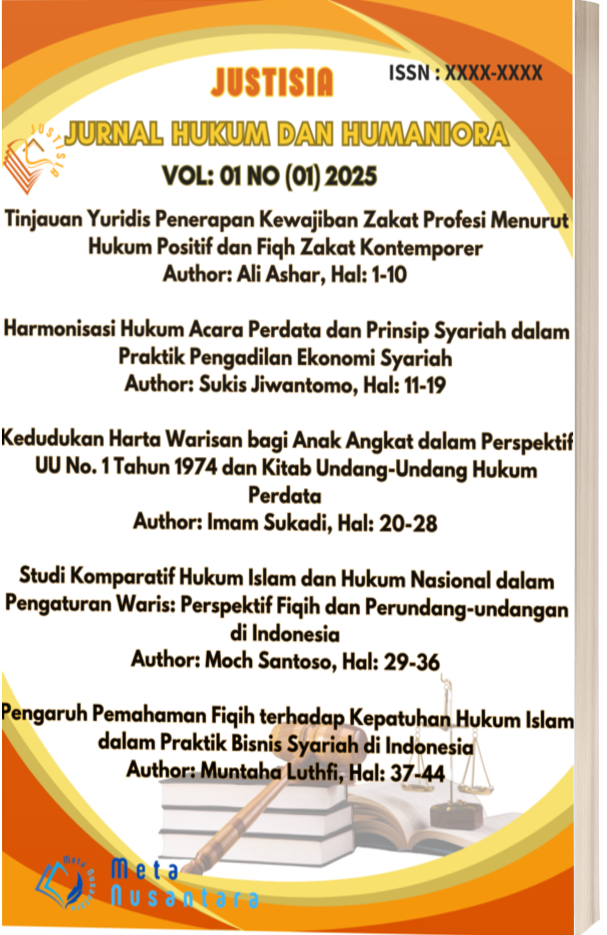
Pengaruh Pemahaman Fiqih terhadap Kepatuhan Hukum Islam dalam Praktik Bisnis Syariah di Indonesia
DOI:
https://doi.org/10.022025/yfgnz120Keywords:
Fiqh Understanding, Sharia Compliance, Islamic BusinessAbstract
This study examines the influence of fiqh understanding on Sharia compliance in Islamic business practices in Indonesia. The research background stems from the rapid growth of the Islamic industry, which still faces challenges in bridging the gap between normative knowledge and operational implementation. The study employs a mixed-methods explanatory sequential design, combining quantitative surveys of 350 Islamic business actors (banking, fintech, MSMEs, capital markets, and insurance) with qualitative in-depth interviews of 15 key informants (practitioners, Islamic economics scholars, and regulators). The research objectives are to: (1) measure the relationship between fiqh understanding and Sharia compliance, (2) identify supporting and inhibiting factors in implementation, and (3) formulate evidence-based policy recommendations. The results demonstrate that fiqh understanding has a significant positive influence on Sharia compliance (r = 0.72; p < 0.01), contributing 51.8% to compliance variation. The Islamic banking sector recorded the highest compliance rate (82%), while MSMEs ranked lowest (54%). Qualitative analysis revealed three key findings: (1) knowledge-practice gaps (68% of respondents), (2) the effectiveness of continuous education in improving compliance (25-40%), and (3) structural barriers such as lack of mentoring (45%). This study provides theoretical contributions by reinforcing the Theory of Planned Behavior in Islamic economics contexts and practical implications through recommendations for developing contextual fiqh modules, strengthening Sharia oversight, and structured mentoring models.
Downloads
References
Al-Ghazali, I. (2017). Al-Maqashid al-Shari'ah: The objectives of Islamic law. Islamic Studies Journal, 24(1), 10-23.
Abdallah, A. (2017). Cognitive-practice gap in Islamic economics: Bridging the gap between theory and practice. Journal of Islamic Economics, 45(3), 213-228.
Ajzen, I. (1991). The theory of planned behavior. Organizational Behavior and Human Decision Processes, 50(2), 179-211. https://doi.org/10.1016/0749-5978(91)90020-T
Chapra, M. U. (2000). The Islamic vision of development in the light of maqasid al-shariah. Islamic Economic Studies, 7(2), 37-47.
DSN-MUI. (2022). Laporan tahunan Dewan Syariah Nasional Majelis Ulama Indonesia 2022. Dewan Syariah Nasional.
Faisal, A. (2022). Dampak pendidikan syariah terhadap kepatuhan bisnis: Studi pada pelaku usaha di sektor UMKM. Jurnal Manajemen Syariah, 18(2), 90-106.
Faricha, F., & Sariman, S. (2024). Peran Lembaga Pendidikan Islam Pada Dalam Membentuk Generasi Muslim Yang Kompetitif. Al Fattah Ejournal Sma Al Muhammad Cepu, 5(02), 36–57.
Hidayati, S. (2021). Literasi fiqih muamalah di kalangan pelaku UMKM syariah. Jurnal Bisnis dan Manajemen Islam, 14(1), 55-72. https://doi.org/10.24042/jbmi.v14i1.3562
Haryono, E., Rangkuti, Rizki Kurniawan, Sariman, S., & Suprihatiningsih, S. (2024). Metodologi Penelitian Kualitatif dan Kuantitatif . Https://Www.Rcipress.Rcipublisher.Org/Index.Php/Rcipress/Catalog/Book/949. Perkumpulan Rumah Cemerlang Indonesia.
Haryono, E., Suprihatiningsih, S., Septian, D., Widodo, J., Ashar, A., & Sariman, S. (2024). New Paradigm Metode Penelitian Kepustakaan (Library Research) di Perguruan Tinggi. An-Nuur, 14(1).
Ismail, H. (2021). Praktik bisnis syariah dan fiqih muamalah di Indonesia: Perspektif teoritis dan praktis. Jurnal Ekonomi Syariah, 12(1), 11-25.
Illah, A., Mansur, R., Hidayatullah, M. F., Sariman, S., & Seena, I. (2022). Principal Leadership in Developing the Competence of Islamic Religious Education Teachers. Nidhomul Haq: Jurnal Manajemen Pendidikan Islam, 7(3). Retrieved from https://www.e-journal.uac.ac.id/index.php/nidhomulhaq/article/view/2658/1077
Muttaqin, F. Z., Anwar, A., Sariman, S., & Almurtaqi, M. R. (2024). Integrasi Nilai-Nilai Al-Quran Dan Hadits Dalam Kurikulum Pembelajaran Bagi Peserta Didik Madrasah Tsanawiyah Al Muhammad Cepu. Al Fattah Ejournal Sma Al Muhammad Cepu, 4(01), 104–113.
Mezirow, J. (2000). Learning as transformation: Critical perspectives on a theory in progress. Jossey-Bass.
Otoritas Jasa Keuangan. (2023). Laporan tahunan perkembangan industri perbankan syariah 2023. Otoritas Jasa Keuangan.
OJK. (2023). Literasi keuangan dan literasi syariah masyarakat Indonesia: Hasil survei 2023. Otoritas Jasa Keuangan.
Rahman, A. (2020). Pengaruh pemahaman syariah terhadap kinerja bank syariah: Studi pada lima bank syariah terkemuka di Indonesia. Jurnal Ekonomi dan Keuangan Islam, 6(3), 95-107.
Scott, W. R. (2014). Institutions and organizations: Ideas, interests, and identities. Sage Publications.
Sariman, Haryono, E., Wahyudin, M., & Muttaqin, F. Z. (2024). Exploring Research Methodologies Qualitative In Higher Education: Strategies And Approaches For Academic Inquiry. Al Fattah Ejournal Sma Al Muhammad Cepu, 4(01), 74–103. Retrieved from https://www.ejournal.smaamc.sch.id/index.php/belajar/article/view/43
Santoso, M. (2025). Etika Profesi Hukum. Meta Nusantara. Blora: Meta Nusantara.
Santoso, M., Habibi, R., Falah, A., & Haryono, E. (2025). Filsafat Umum. Meta Nusantara. Blora: Meta Nusantara. Retrieved from https://repository.metanusantara.com/publications/617595/filsafat-umum#cite
Zainuddin, M. (2020). Pendekatan teori maqashid syariah dalam pengelolaan bisnis syariah di Indonesia. Jurnal Ekonomi Islam, 8(2), 119-134.
Downloads
Published
Issue
Section
License
Copyright (c) 2025 Muntaha Luthfi (Author)

This work is licensed under a Creative Commons Attribution 4.0 International License.