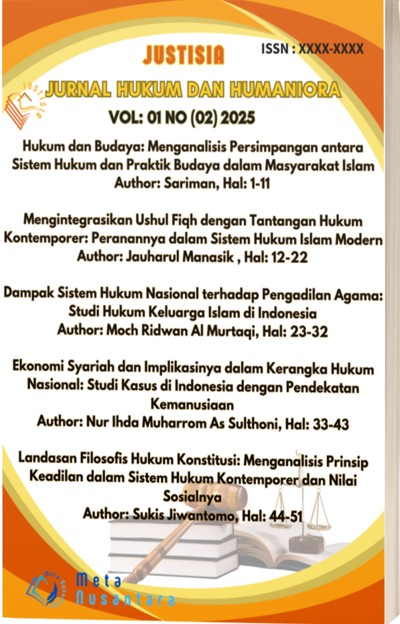
Dampak Sistem Hukum Nasional terhadap Pengadilan Agama: Studi Hukum Keluarga Islam di Indonesia
DOI:
https://doi.org/10.022025/ghy3w565Keywords:
Islamic Family Law, Religious Courts, National Legal SystemAbstract
This study examines the impact of the national legal system on the Religious Court (PA) in the context of Islamic family law in Indonesia. The main objective of this study is to identify the pattern of interaction between state law and Islamic law in the PA decision and understand the impact of the application of national law on judges' decisions in marriage and inheritance cases. This type of research is qualitative with a case study approach, which involves an analysis of 25 PA decisions published between 2020-2024 and interviews with 12 PA Judges. This research also uses document analysis and field studies to explore the dynamics that occur in the Religious Courts related to the application of state law. The results showed three main patterns in the impact of the national legal system on PA: (1) harmonization of norms, (2) selective resistance, and (3) interpretive transformation. This finding shows that most marriage cases, such as marriage dispensation and different religious marriages, adopted national law, while some inheritance cases still show rejection of state intervention. In addition, socio-juridical considerations, such as child protection and gender equality, are increasingly dominant in the decision of the PA judge. This study concluded the importance of strengthening synchronization between religious law and state law to create a more harmonious legal system.
Downloads
References
Arifin, S. (2020). Konstitusionalisasi hukum Islam: Peran Mahkamah Konstitusi dalam membatasi kewenangan Pengadilan Agama [Constitutionalization of Islamic law: The role of the Constitutional Court]. *Al-Ahkam, 30*(1), 1–24. https://doi.org/10.21580/ahkam.2020.30.1.5432
Benda-Beckmann, F. (2009). Legal pluralism and social justice in economic and political development. Springer.
Bowen, J. R. (2003). Islam, law, and equality in Indonesia: An anthropology of public reasoning. Cambridge University Press.
Cammack, M. (2007). Islamic divorce law and practice in Indonesia. Islamic Law and Society, 14(1), 1–28. https://doi.org/10.1163/156851907X170420
Fauzan, A. (2018). Reformasi hukum keluarga Islam di Indonesia: Antara fiqih dan negara [Reform of Islamic family law in Indonesia: Between fiqh and the state]. Jurnal Hukum Islam, 16(2), 45–67. https://doi.org/10.15642/JHI.2018.16.2.45-67
Griffiths, J. (1986). What is legal pluralism? Journal of Legal Pluralism and Unofficial Law, 18(24), 1–55. https://doi.org/10.1080/07329113.1986.10756387
Hallaq, W. B. (2009). Sharī'a: Theory, practice, transformations. Cambridge University Press.
Haryono, E., Rangkuti, Rizki Kurniawan, Sariman, S., & Suprihatiningsih, S. (2024). Metodologi Penelitian Kualitatif dan Kuantitatif . Https://Www.Rcipress.Rcipublisher.Org/Index.Php/Rcipress/Catalog/Book/949. Perkumpulan Rumah Cemerlang Indonesia.
Haryono, E., Suprihatiningsih, S., Septian, D., Widodo, J., Ashar, A., & Sariman, S. (2024). New Paradigm Metode Penelitian Kepustakaan (Library Research) di Perguruan Tinggi. An-Nuur, 14(1).
Hazairin. (1962). Hukum kekeluargaan nasional [National family law]. Tintamas.
Hooker, M. B. (2008). Indonesian syariah: Defining a national school of Islamic law. Institute of Southeast Asian Studies.
Ka’anto, K., Jiwantomo, S., & Chandra, A. N. (2025). Metode Penelitian Kualitatif Dan Kuantitatif (Teori dan Aplikasi Disertai Contoh Proposal). Meta Nusantara. Blora: Meta Nusantara. Retrieved from https://repository.metanusantara.com/publications/617596/metode-penelitian-kualitatif-dan-kuantitatif-teori-dan-aplikasi-disertai-contoh#cite
Nurlaelawati, M. (2019). The marriage age controversy in post-reform Indonesia: A legal pluralism perspective. Journal of Indonesian Islam, 13(2), 345–368. https://doi.org/10.15642/JIIS.2019.13.2.345-368
Otto, J. M. (2010). Sharia incorporated: A comparative overview of the legal systems of twelve Muslim countries. Leiden University Press.
Pompe, S. (2005). The Indonesian Supreme Court: A study of institutional collapse. Cornell Southeast Asia Program.
Rofiq, A. (2021). Dialektika hukum Islam dan hukum nasional dalam putusan Pengadilan Agama [Dialectics of Islamic law and national law in Religious Court decisions]. Pandecta, 16(1), 12–30. https://doi.org/10.15294/pandecta.v16i1.28901
Salim, A. (2015). Contemporary Islamic law in Indonesia: Sharia and legal pluralism. Edinburgh University Press.
Sariman, Haryono, E., Wahyudin, M., & Muttaqin, F. Z. (2024). Exploring Research Methodologies Qualitative In Higher Education: Strategies And Approaches For Academic Inquiry. Al Fattah Ejournal Sma Al Muhammad Cepu, 4(01), 74–103. Retrieved from https://www.ejournal.smaamc.sch.id/index.php/belajar/article/view/43
Zuhri, S. (2017). Politik hukum peradilan agama di Indonesia [The legal politics of Religious Courts in Indonesia]. Mazahib, 16(2), 1–20. https://doi.org/10.21093/mj.v16i2.1015
Downloads
Published
Issue
Section
License
Copyright (c) 2025 Moch Ridwan Al Murtaqi (Author)

This work is licensed under a Creative Commons Attribution 4.0 International License.