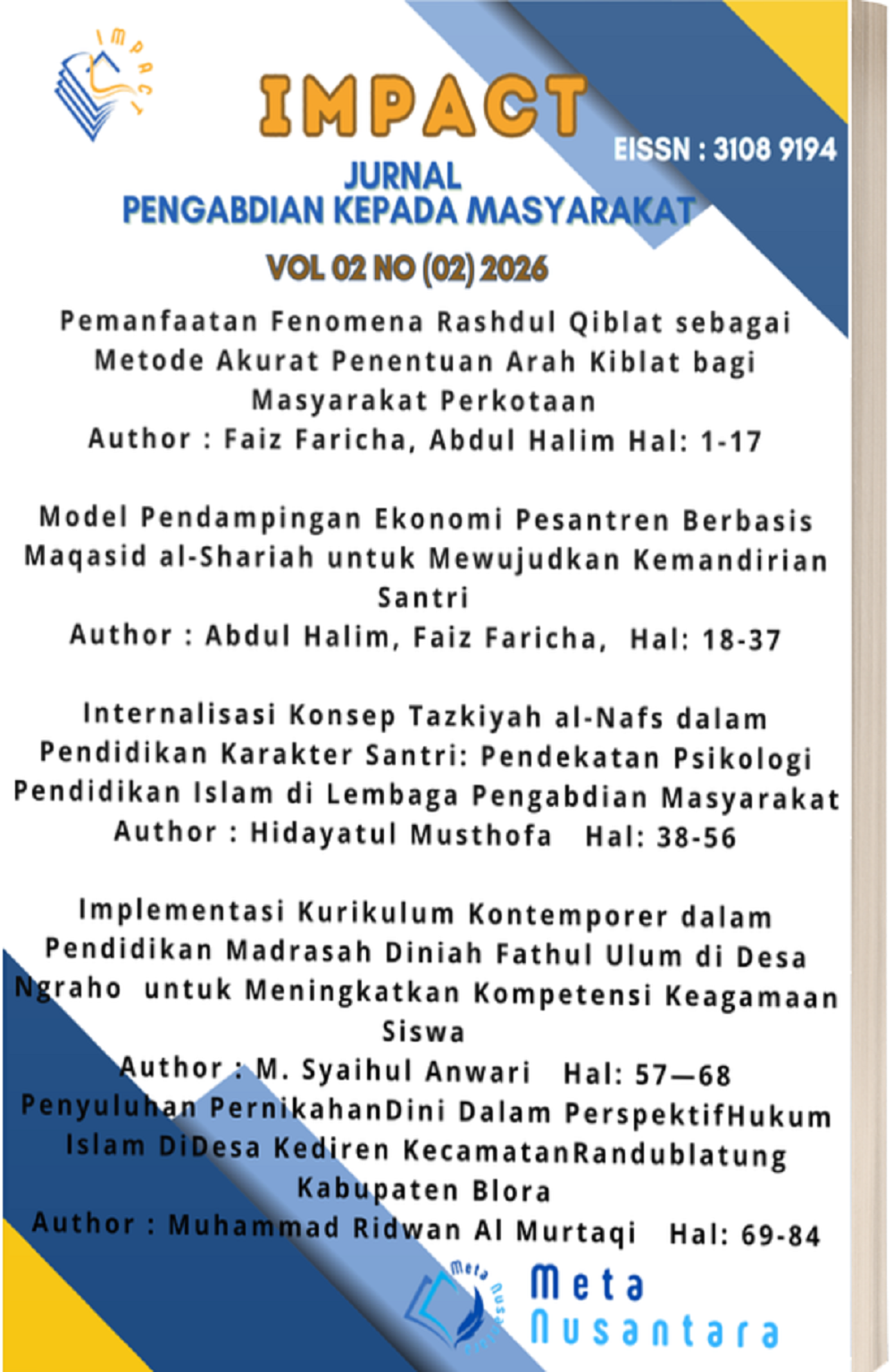
Model Pendampingan Ekonomi Pesantren Berbasis Maqasid al-Shariah untuk Mewujudkan Kemandirian Santri
DOI:
https://doi.org/10.010425/egfq6767Keywords:
Islamic Boarding School Economic Assistance, Maqasid al-Shariah, Student IndependenceAbstract
Islamic boarding schools as the oldest Islamic educational institution in Indonesia face the challenge of transformation from institutions that depend on donations to independent economic entities, but the reality shows that economic management and student empowerment are still weak. This research aims to develop a model of economic assistance for Islamic boarding schools based on Maqasid al-Shariah that is effective in realizing the independence of students. The research uses a Participatory Action Research (PAR) approach with the active participation of kyai, pesantren administrators, and students in three Islamic boarding schools in East Java and West Java. Data were collected through participatory observation, in-depth interviews, focus group discussions, and documentation. The results of the study show three main findings. First, the mentoring model developed integrates the five dimensions of Maqasid al-Shariah (maintenance of religion, soul, intellect, descent, and property) into the entire mentoring cycle and has been proven to increase business unit revenue by an average of 45% and student participation from 15% to 72%. Second, before the mentoring, the contribution of business units to pesantren operations was only 23% and the entrepreneurial literacy of students was at a score of 42, but after three cycles of PAR there was a significant increase in all indicators. Third, the success of the implementation of the model is determined by the commitment of the kyai and the availability of resources, while obstacles such as limited capital and low financial literacy are overcome through intensive mentoring. The research concludes that the Maqasid al-Shariah-based mentoring model is effective in increasing the independence of students and contributing to the development of the Islamic economy as well as practical guidance for sustainable Islamic boarding school economic management.
Downloads
References
al-Shatibi, A. I. (2014). Al-Muwafaqat fi Usul al-Shariah (Vol. 2). Dar al-Kutub al-Ilmiyyah.
Amin, M., Hasan, A., & Rahmat, S. (2023). Model pemberdayaan ekonomi berbasis pesantren di Pondok Pesantren Nurul Islam Jember. Jurnal Ekonomi Islam, *15*(2), 145-162.
Askari, H., Iqbal, Z., & Mirakhor, A. (2021). Introduction to Islamic economics: Theory and application. Wiley.
Aziz, R., & Qodir, Z. (2022). Pesantren dan pemberdayaan ekonomi komunitas: Studi kasus di Jawa Timur. Jurnal Sosiologi Islam, *12*(1), 78-95.
Azra, A. (2020). Pendidikan Islam: Tradisi dan modernisasi di tengah tantangan milenium III. Kencana.
Chapra, M. U. (2020). The future of economics: An Islamic perspective. The Islamic Foundation.
Coghlan, D., & Brydon-Miller, M. (Eds.). (2014). The SAGE encyclopedia of action research. SAGE Publications.
Creswell, J. W. (2014). Research design: Qualitative, quantitative, and mixed methods approaches (4th ed.). SAGE Publications.
Dhofier, Z. (2019). Tradisi pesantren: Studi tentang pandangan hidup kyai. LP3ES.
Dusuki, A. W., & Abozaid, A. (2022). A critical appraisal on the challenges of realizing maqasid al-Shariah in Islamic banking and finance. ISRA International Journal of Islamic Finance, *14*(2), 112-128.
Fahmi, M., & Aswirna, P. (2023). Potensi ekonomi pesantren di Indonesia: Analisis pemanfaatan sumber daya internal. Jurnal Ekonomi dan Bisnis Islam, *9*(1), 45-62.
Hakim, L., & Kurniawan, D. (2024). Literasi kewirausahaan santri: Hambatan dan solusi pengembangan ekonomi pesantren. Jurnal Pendidikan Islam, *12*(2), 201-218.
Hidayat, T., & Rahman, F. (2023). Ketergantungan pendanaan eksternal pesantren dan implikasinya terhadap kemandirian ekonomi. Jurnal Manajemen Pendidikan Islam, *11*(1), 88-105.
Ibn Ashur, M. T. (2019). Treatise on Maqasid al-Shariah. The International Institute of Islamic Thought.
Kemmis, S., McTaggart, R., & Nixon, R. (2014). The action research planner: Doing critical participatory action research. Springer.
Kementerian Agama Republik Indonesia. (2023). Petunjuk teknis program Santripreneur dan penguatan koperasi pesantren. Direktorat Jenderal Pendidikan Islam.
Lincoln, Y. S., & Guba, E. G. (1985). Naturalistic inquiry. SAGE Publications.
Mardikanto, T., & Soebianto, P. (2020). Pemberdayaan masyarakat dalam perspektif kebijakan publik. Alfabeta.
Miles, M. B., Huberman, A. M., & Saldaña, J. (2014). Qualitative data analysis: A methods sourcebook (3rd ed.). SAGE Publications.
Mubarak, H., & Nasution, I. (2022). Pola pendanaan pesantren dan tantangan kemandirian ekonomi di era kontemporer. Jurnal Ilmu Sosial dan Ekonomi Islam, *8*(2), 134-151.
Reason, P., & Bradbury, H. (Eds.). (2008). The SAGE handbook of action research: Participative inquiry and practice (2nd ed.). SAGE Publications.
Rohim, Y. N., & Pratama, B. B. (2025). Santripreneur education model based on the Maqashid Al-Syariah framework for the economic empowerment of santri in pesantren. Islamic Banking: Jurnal Pemikiran dan Pengembangan Perbankan Syariah, *11*(1), 81-98. https://doi.org/10.36908/isbank.v11i1.1543[reference:0][reference:1]
Rohman, A., & Setiawan, B. (2024). Integrasi nilai-nilai Maqasid al-Shariah dalam pengelolaan unit usaha pesantren. Jurnal Ekonomi Syariah, *13*(1), 67-84.
Stringer, E. T. (2020). Action research (5th ed.). SAGE Publications.
Suharto, E. (2023). Pendampingan sosial dan pemberdayaan masyarakat: Konsep, strategi dan implementasi. Pustaka Pelajar.
Suryani, N., & Maulidiyah, R. (2021). Rendahnya literasi kewirausahaan santri: Faktor penghambat pengembangan ekonomi pesantren. Jurnal Pendidikan dan Ekonomi, *10*(3), 190-207.
Wahid, A. (2021). Pesantren dan pemberdayaan ekonomi umat. Pustaka Cendekia.
Wisudawan, A., Santoso, B., & Hakim, L. (2025). Pemberdayaan santri di pesantren: Tinjauan literatur sistematis. Jurnal Pendidikan Islam Indonesia, *9*(1), 23-41.
Yustanti, E., Rohim, Y. N., & Pratama, B. B. (2025). Kerangka konseptual kewirausahaan sosial berbasis maqashid al-shariah untuk pengembangan ekonomi pesantren. Jurnal Ekonomi Syariah, *14*(1), 55-73.
Zaid, M., Amin, A., & Qodir, Z. (2024). Praktik kewirausahaan pesantren dan implementasi maqasid shariah: Studi kasus Pondok Pesantren Raudhatul Ulum. Jurnal Ilmu Falak dan Ekonomi Islam, *8*(2), 112-130.
Downloads
Published
Issue
Section
License
Copyright (c) 2026 Abdul Halim, Faiz Faricha (Author)

This work is licensed under a Creative Commons Attribution 4.0 International License.