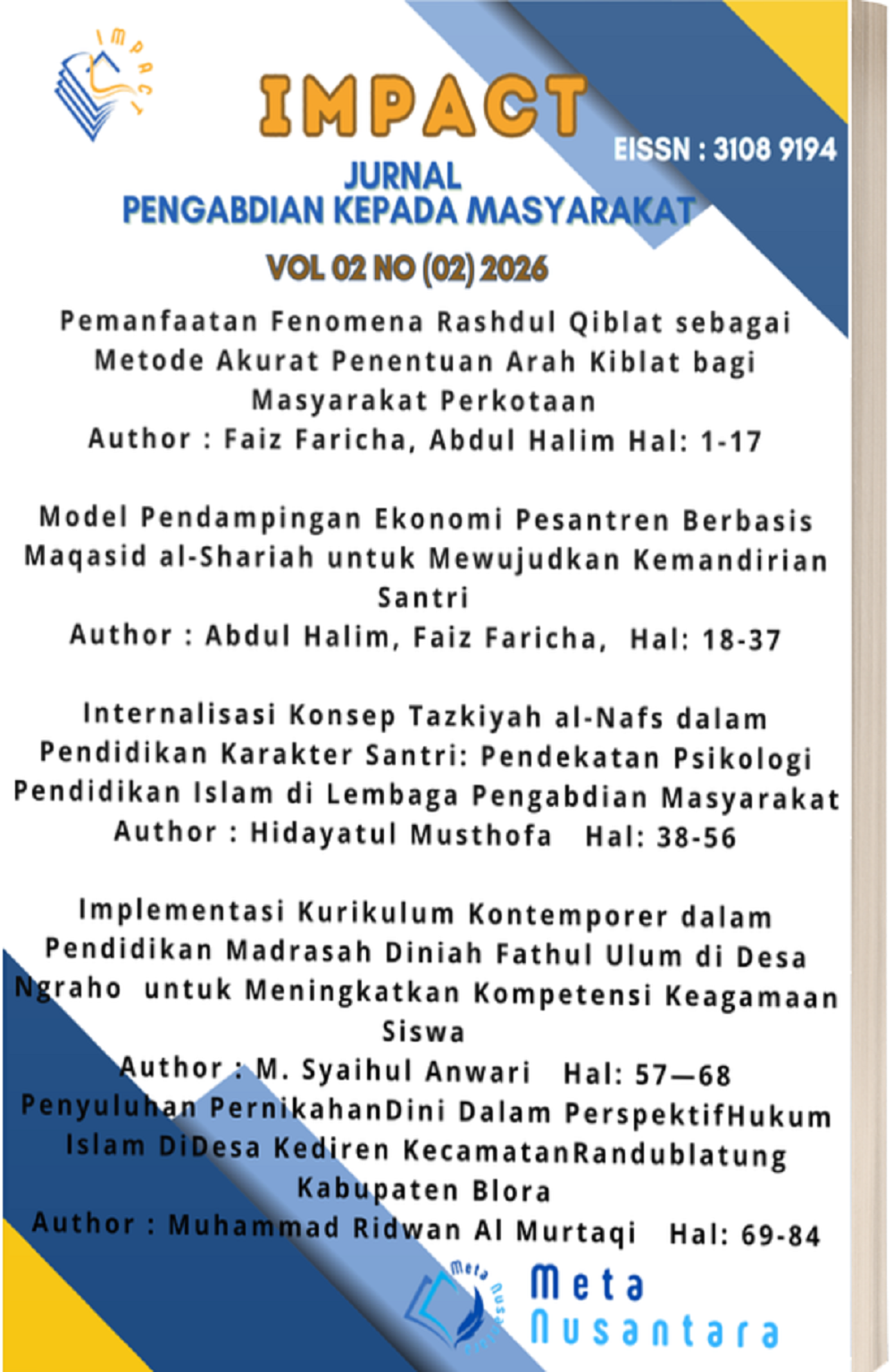
Internalisasi Konsep Tazkiyah al-Nafs dalam Pendidikan Karakter Santri: Pendekatan Psikologi Pendidikan Islam di Lembaga Pengabdian Masyarakat
DOI:
https://doi.org/10.010425/naadxb26Keywords:
Tazkiyah Al-Nafs, Student Character Education, Islamic Education PsychologyAbstract
Character education in Islamic boarding schools faces complex challenges in the midst of globalization and modernization that erode the spiritual and moral values of students. The concept of tazkiyah al-nafs or purification of the soul offers a holistic approach that touches the psychological and spiritual dimensions simultaneously in shaping the personality of students with noble character. This research aims to internalize the concept of tazkiyah al-nafs in the character education of students through the psychology approach of Islamic education in community service institutions. The research uses the Participatory Action Research (PAR) approach which is carried out in three cycles at Islamic Boarding Schools [the name of the Islamic Boarding School]. The primary data sources came from 10 caregivers and teachers as active participants, 50 students as respondent participants, and all students and parents as beneficiary participants. Data were collected through participatory observation, in-depth interviews, focus group discussions (FGDs), and psychometric scales that have been tested for validity and reliability. The results showed that the internalization of tazkiyah al-nafs through the stages of takhalli (emptying the soul from reprehensible qualities), tahalli (adorning the soul with praiseworthy qualities), and tajalli (the revelation of divine light) proved to be effective in improving the Islamic character of students (p < 0.001, Cohen's d = 1.45), spiritual awareness (p < 0.001, Cohen's d = 1.52), and worship discipline (p < 0.001, Cohen's d = 1.63). This service program has also succeeded in empowering Islamic boarding schools through the formation of a core team that ensures the sustainability of the program independently. This study recommends the development of a tazkiyah al-nafs-based service model that can be replicated in various Islamic boarding schools in Indonesia.
Downloads
References
Al-Ghazali, A. H. (2004). Ihya' Ulumuddin (terjemahan). Penerbit Darul Ihya.
Fahrudin. (2017). Model pendidikan tazkiyahtun nafs sebagai upaya membentuk akhlak mulia santri di Pondok Pesantren Al-Huda Kuningan Jawa Barat. Jurnal Pendidikan Agama Islam – Ta'lim, 15(1).
Habib, M. (2016). Konsep tazkiyahtun nafs menurut Ibnu Qoyyim al-Jauziyah dalam kitab Madarijus Shalikin serta implikasinya terhadap pendidikan. Jurnal Ta'dibi, 5(2).
Hawwa, S. (1995). Intisari Ihya' 'Ulumuddin al-Ghazali: Mensucikan jiwa dan konsep tazkiyatun-nafs terpadu. Robbani Press.
Haryono, E., Al Murtaqi, M. R., Izzah, A. N. L., Septian, D., & Sariman, S. (2024). Metode-Metode Pelaksanaan PkM (Pengabdian Kepada Masyarakat) Untuk Perguruan Tinggi. Al Fattah Ejournal Sma Al Muhammad Cepu, 5(02), 1–21.
Karim, B. A., & Hasibuddin, M. (2022). Revolusi mental melalui pendidikan Islam berbasis metode tazkiyatun nafs. Jurnal Pendidikan Islam, 11(2), 145–158.
Komsiyah, I. (2012). Belajar dan pembelajaran. Teras.
Lickona, T. (2012). Educating for character: How our schools can teach respect and responsibility. Bantam Books.
Mustofa, D. (2025). Nilai-nilai psikologi religius dalam al-Qur'an dan relevansinya terhadap pembentukan karakter santri. Journal of Islamic Scriptures in Non-Arabic Societies.
Ni'mah, U. (2018). Konsep tazkiyatun nafs dan implikasinya terhadap pendidikan karakter pada Kurikulum 2013: Telaah buku Ihyā' ‘Ulum Ad-Dīn karya Imam Al-Ghazali [Tesis magister, Universitas Islam Negeri Maulana Malik Ibrahim].
Naim, A., & Sariman, S. (2022). Internalization of Character Values in Through the Learning of Ta’līm Al-Muta’allim Book. Scaffolding: Jurnal Pendidikan Islam Dan Multikulturalisme, 4(2), 25–40.
Rizki, A., Al Hamat, A., & Muhyani. (2021). Model pendidikan kepemimpinan berbasis tazkiyah al nafs. Islamic Management: Jurnal Manajemen Pendidikan Islam, 4(1), 139-152.
Rozi, M. F., Maskuri, M., Ghoni, D., Madyan, S., Sariman, S., & Haryono, E. (2026). Multicultural Islamic Education Model Based on Salaf Tradition in Islamic Boarding School. ASEAN Journal of Religion, Education, and Society, 5(2), 81–88.
Rozi, M. F., Sariman, S., & Khasanudin, M. (2022). Development of religious character through the implementation of ta’lim al-muta’allim. Scaffolding: Jurnal Pendidikan Islam Dan Multikulturalisme, 4(2), 83–98.
Sariman, S., & Mutaqien, F. Z. (2025). Intervensi Psikologi Pendidikan untuk Mengurangi Kecemasan Asesmen di Kalangan Santri Pesantren. Al Fattah Ejournal Sma Al Muhammad Cepu, 6(01), 21–30.
Setiawan, A. A. (2018). Konsep tazkiyatun al-nafs perspektif Imam Al-Ghazali dalam kitab Ihya Ulumuddin sebagai metode pendidikan akhlak [Skripsi, Universitas Islam Syekh-Yusuf Tangerang].
Shafwan, M. H., & Abdullah, M. M. (2024). Implementasi pendidikan tauhid dalam membentuk karakter santri Pondok Pesantren Tahfidzul Qur'an Imam An Nawawi Batam. Jurnal Staika: Jurnal Penelitian dan Pendidikan, 7(1), 33-46.
Shaleh, A. R. (2009). Psikologi: Suatu pengantar dalam perspektif Islam. Prenada Media Group.
Subaidi, & Jahari, J. (2021). Pendidikan agama Islam tazkyatun nafs sebagai upaya penguatan kepribadian guru di Madrasah Aliyah. Jurnal Pendidikan Agama Islam, 9(1), 78–92.
Susanti, D. (2021). Pembinaan karakter santri melalui pendekatan tazkiyatun nafs menurut Imam Al-Ghazali. Jurnal Studi Islam, 12(2), 210–225.
Ulya, M., & Firdaus, M. (2023). Internalisasi nilai-nilai akhlak melalui metode tazkiyah al-nafs di pondok pesantren. Jurnal Pendidikan Karakter, 8(1), 56–72.
Wahyudi, M. (2001). Pembinaan akhlakul karimah. Citra Umbara.
Zaenuri, A. (2025). Implementasi metode penyucian jiwa (tazkiyatun nafs) perspektif Imam Al-Ghazali dalam pemeliharaan karakter disiplin ibadah santri [Tesis magister, Universitas Islam Sultan Agung Semarang]
Downloads
Published
Issue
Section
License
Copyright (c) 2026 Hidayatul Musthofa (Author)

This work is licensed under a Creative Commons Attribution 4.0 International License.