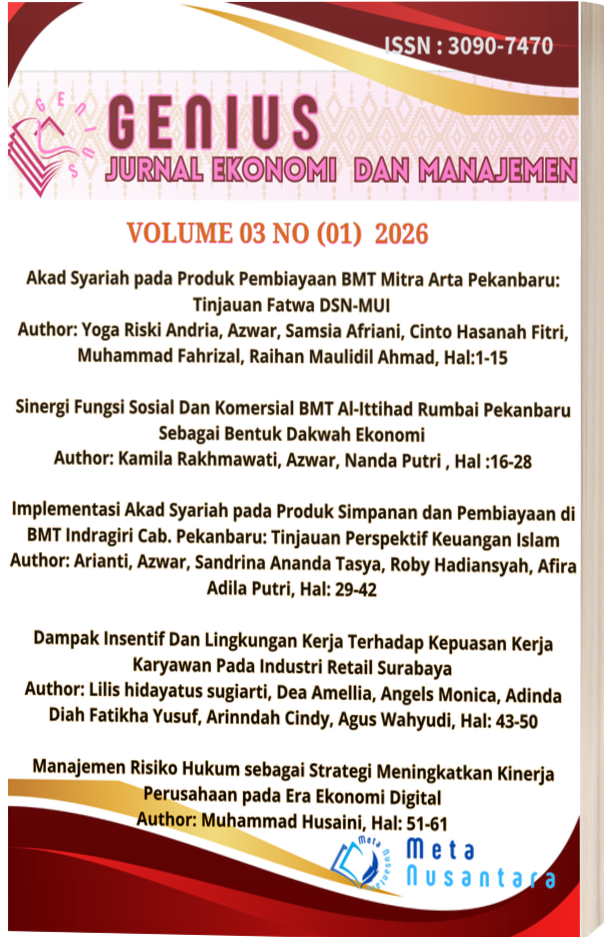
Implementasi Akad Syariah pada Produk Simpanan dan Pembiayaan di BMT Indragiri Cab. Pekanbaru: Tinjauan Perspektif Keuangan Islam
DOI:
https://doi.org/10.010124/6zkemz07Keywords:
Implementation of Sharia Contracts; Baitul Maal wa Tamwil (BMT); Islamic Finance;Abstract
The rapid growth of Islamic financial institutions in Indonesia is still accompanied by a gap between Islamic financial literacy and inclusion. This study employs a field research design with a descriptive qualitative approach. Data were collected through interviews with parties involved in the implementation of savings and financing products to obtain information regarding the application of Islamic contracts in the institutions’ operations. The collected data were then analyzed using an interactive data analysis model. Interactive data analysis involves three stages: data reduction, data presentation, and drawing conclusions or verification. The objective of this study is to analyze the implementation of Sharia contracts in savings and financing products at BMT Indragiri’s Pekanbaru Branch and to assess their compliance with Islamic financial principles. The research findings indicate that the implementation of Sharia contracts for savings and financing products at the Pekanbaru Branch of BMT Indragiri is in accordance with the principles of Islamic finance. Savings products utilize wadiah yad dhamanah, mudharabah, and musyarakah contracts, while financing products utilize murabahah, mudharabah, musyarakah, ijarah, and qardhul hasan contracts. The application of these contracts is carried out clearly, transparently, and based on mutual agreement between both parties, thereby avoiding elements of riba, gharar, and injustice. Additionally, the BMT fulfills its social function through qardhul hasan financing and the collection of social funds to assist the community. However, this study also found that public understanding of Sharia contracts still needs to be improved through more intensive outreach and education.
Downloads
References
Abdurohman, D., Putra, H. M., & Ahyani, H. (2022). Sumber Dan Norma Ekonomi Syariah Dalam Lembaga Keuangan Syariah (LKS) Perbankan Syariah Dan Koperasi Syariah. Ecobankers : Journal of Economy and Banking, 3(1), 22–29. https://doi.org/10.47453/ecobankers.v3i1.878
Akbar, Rahmat, Kamal, J., Zain, I., & Putra, F. S. (2023). Lembaga Keuangan Syariah. Deepublish.
Alimuddin, A. (2020). Bentuk Akad-Akad Bernama Di Lembaga Keuangan Syariah. AMAL: Jurnal Ekonomi Syariah, 2(2). https://doi.org/10.33477/eksy.v2i02.1716
Amalia, F. A. (2022). Hukum Akad Syariah. ISLAMITSCH FAMILIERECHT JOURNAL, (01), 68–81. https://doi.org/10.32923/ifj.v3i01.2454
Arafah, A., Anggraini, D., & Kinanti, S. C. (2023). Implementasi Prinsip-Prinsip Syariah Pada Lembaga Keuangan Syariah. Studia Economica : Jurnal Ekonomi Islam.
Hasanah, D. (2024). Prinsip Akad Dalam Hukum Ekonomi Syariah Dan Implikasinya Dalam Transaksi Bisnis. Journal of Legal Studies, 2(2).
Kurniawan, M. (2021). Bank dan Lembaga Keuangan Syariah (Teori dan Aplikasi. Adab.
Lestari, W. D., & Wansyah, M. I. (2025). Analisis Penyimpangan Prinsip Syariah Dalam Implementasi Akad Murabahah Pada Lembaga Keuangan Syariah Di Indonesia. EKONOMIPEDIA Jurnal Ekonomi Manajemen Dan Bisnis.
Rafsanjani, H. (2016). AKAD TABARRU’ DALAM TRANSAKSI BISNIS. Jurnal Masharif Al-Syariah, (1).
Ramdani Harahap, S. A., & Ghozali, M. (2020). Peran Baitul Mal Wa Tamwil (Bmt) Dalam Pengembangan Ekonomi Umat. HUMAN FALAH: Jurnal Studi Ekonomi dan Bisnis Islam, 7(1). https://doi.org/10.30829/hf.v7i1.4058
Riyadi, M. I., Setiawan, C., Triyuliani, N., Nurjanah, L., Raharjo, A. G. G., Sefnado, A., Hadyanto, S., Kartika, D., Akmal, S. A., & Nugroho, F. A. (2025). Survei Nasional Literasi Dan Inklusi Keuangan (SNLIK) 2025. Otoritas Jasa Keuangan.
Rosadi, I. (2025). Telaah Filsafat Hukum Islam Terhadap Akad Dalam Kebijakan Ekonomi Syariah. Equality: Journal of Islamic Law (EJIL), 3(2), 193–208. https://doi.org/10.15575/ejil.v3i2.1978
Saeed, A. (1999). Islamic Banking and Interest: A study of the Prohibition Of Riba and its Contemporary Interpretation. University of Melbourne.
Sahla, H., Inayah, H., & Sudiarti, S. (2023). Implementasi Akad Wakalah di Lembaga Keuangan Syariah. Jurnal Ekonomi Syariah Pelita Bangsa, 08(02).
Saputri, S. N. A. Y., Nabilah, M. F., & Indra, F. S. (2025). Integrasi Baitul Mal Dan Akad Qardhu Hasan Dalam Pembangunan Ekonomi Umat.
Solekha, Y. A., Murdianah, A. Q., Lestari, N. S., & Asytuti, R. (2021). Baitul Maal Wa Tamwil Sebagai Lembaga Keuangan Mikro Syariah Pemberdaya Ekonomi Umat (Konsep dan Teori). Velocity: Journal of Sharia Finance and Banking, 1(1), 44–58. https://doi.org/10.28918/velocity.v1i1.3647
Sugiyono. (2017). Metode Penelitian Kuantitatif, Kua litatif, dan R&D. ALFABETA.
Undang-Undang Republik Indonesia Nomor 21 Tahun 2008 Tentang Perbankan Syariah, 21 (2008). https://peraturan.bpk.go.id/Home/Details/39653/uu-no-21-tahun-2008
Wahid, N. (2020). Multi Akad Dalam Lembaga Keuangan Syariah. Deepublish.
Downloads
Published
Issue
Section
License
Copyright (c) 2026 Arianti, Azwar, Sandrina Ananda Tasya, Roby Hadiansyah, Afira Adila Putri (Author)

This work is licensed under a Creative Commons Attribution 4.0 International License.